
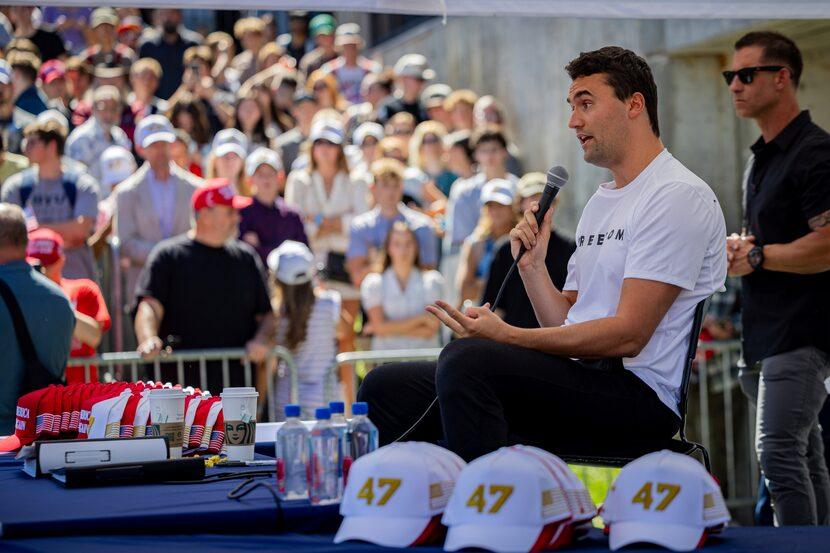
A Reflection on the Death of Charlie Kirk and the Trial of His Assassin

Dear Friend,
God makes no mistake in creating humanity in diverse cultures, lands, and traditions. Our diversity is not a weakness but a gift. It adds color to the single tapestry of our shared humanity. As the Apostle Paul reminds us, “There are different kinds of gifts, but the same Spirit distributes them. There are different kinds of service, but the same Lord” (1 Corinthians 12:4–5).
We live in a culturally, religiously, geographically, and socially diverse world. Each of us is shaped by history, heritage, upbringing, and personal convictions. We hold differing ideologies, political perspectives, and religious views. These variations define our uniqueness as people of the world. Those of the same faith gather in their places of worship to pray according to their traditions. Those active in politics align with parties, whether Republican, Democrat, Independent, or otherwise, to advance their shared ideals. These pluralities, though sometimes contentious, also enrich our humanity.
Yet differences must never become a source of division. As St. Augustine taught, “In essentials, unity; in non-essentials, liberty; in all things, charity.” Disagreement does not make us enemies. If my belief differs from yours, I am still your neighbor. If you dislike my ideology, I must not be seen as your adversary. Our humanity, our shared dignity as persons made in the image and likeness of God, transcends mere human ideology.
Religious tolerance, enshrined in the U.S. Constitution under the First Amendment, guarantees freedom of belief and conscience. Political pluralism is the lifeblood of democracy. Ethical teaching demands that we respect freedom while ensuring that freedom does not breed violence. Pope St. John Paul II reminded us, “Freedom consists not in doing what we like, but in having the right to do what we ought.”
Violence, however, is never the answer. To kill another because of political or religious hatred is to betray both justice and humanity. Jesus himself said, “Put your sword back in its place, for all who draw the sword will die by the sword” (Matthew 26:52). The martyrdom of Christ did not silence his truth, but instead revealed that truth cannot be overcome by unjust condemnation. History teaches us the same: the assassination of Abraham Lincoln did not kill democracy, the silencing of Martin Luther King Jr. did not destroy the dream of racial justice, and the death of St. Oscar Romero did not end the Church’s call for peace and human dignity. In the same way, the death of Charles Kirk will never bring his vision or his movement to an end.
As we mourn the painful death of Charles Kirk, we must resist the temptation to resort to violence or to hateful words. In this precious time that God has entrusted to us, we are called to make a positive impact in our world. Shakespeare was right when he wrote, “All the world’s a stage, and all the men and women merely players, they have their exits and their entrances.” None of us remains forever in this mortal world. Life is a gift, fragile and fleeting. “The wages of sin is death, but the free gift of God is eternal life in Christ Jesus” (Romans 6:23).
Let us therefore sheath our political, cultural, and religious swords. Let us bind ourselves together in the greater truth that love is stronger than hate. Violence divides, love reconciles. Political vengeance destroys, forgiveness renews. As the fathers of the American nation proclaimed, “We hold these truths to be self-evident, that all men are created equal, endowed by their Creator with certain unalienable Rights.” These rights cannot coexist with hatred and political bloodshed.
The death of Charles Kirk calls us not to despair but to unity. May we honor his memory not with bitterness, but with a renewed commitment to building a nation and world where justice, compassion, tolerance, freedom of speech, and love prevail. Let us build a nation where our children will grow as free citizens, able to speak without fear, and not live as cowards afraid of dying by gunshot. Let us be peacemakers, for “Blessed are the peacemakers, for they shall be called children of God” (Matthew 5:9). May love lead us, lest division consume us, because united we stand, but divided we surely fall.
Peace and blessings
Dr. C.C. Aladi