
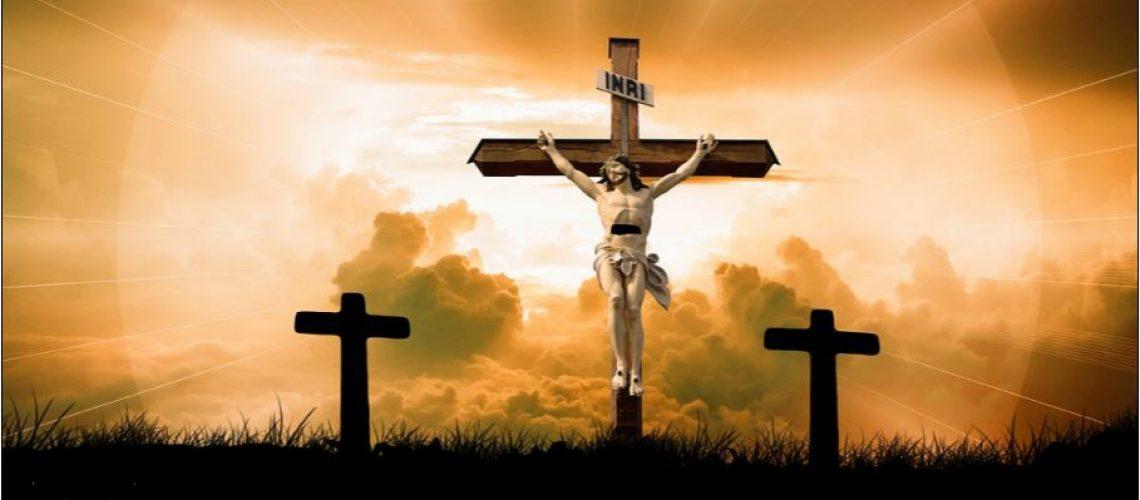
Homily for the Feast of the Exaltation of the Holy Cross, September 14, 2025
“Through the cross we are reconciled to God, made sons and not slaves, friends and not enemies; the cross is the destruction of enmity, the guarantee of peace, the treasure house of many blessings.”
— St. John Chrysostom (Homilies on the Epistle to the Colossians)
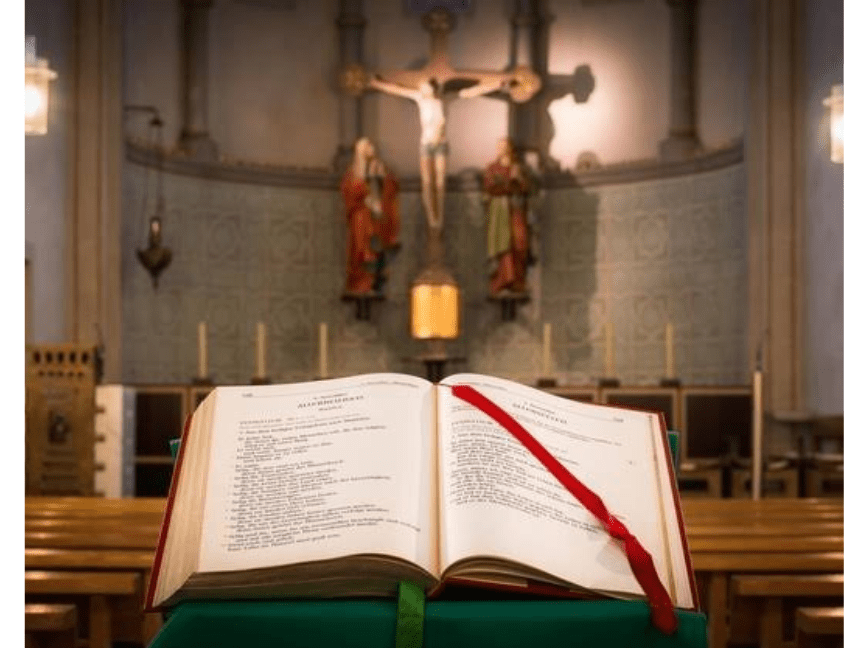
Readings For The Feast Day
My Dearest Friends in Christ,
Today, we gather not to mourn the Cross, but to exalt it. We celebrate it not as an instrument of shameful death, but as the very throne of life and the key to our salvation. This feast, the Exaltation of the Holy Cross, has its origins in the 4th century. After centuries of persecution, the Emperor Constantine legalized Christianity. His mother, St. Helena, a woman of deep faith even in her old age, journeyed to Jerusalem to find the holy places of Christ’s life. Through diligent excavation, she discovered three crosses. To identify the True Cross upon which our Savior died, the tradition tells us that a dying woman was brought to touch each one. Upon touching the third cross, she was miraculously healed. From that moment, the wood of the Cross was venerated as the source of our healing and our hope. Today, we are invited to do the same: to look upon this sacred symbol and find not death, but eternal life.
In a world that often tells us to seek power, prestige, and personal comfort, the Cross stands as a stark contradiction. We live in an age of digital connection, yet many people still feel a deep spiritual emptiness. People look for meaning in success, in likes, in possessions, and yet they find only a hollow ache. They are bitten, like the Israelites in the desert, by the serpents of anxiety, despair, and sin. They are dying of thirst in a spiritual desert, complaining that there is no food or water, no meaning to be found. They need a remedy. They need a sign to look upon and live.
This is precisely what God provides in our first reading from the Book of Numbers. The Israelites, worn down by their journey, fall into the sin of complaining against God and Moses. In their punishment, they are bitten by seraph serpents. But God, in His infinite mercy, does not abandon them. He instructs Moses to lift up a bronze serpent on a pole, and whoever looks upon it in faith is healed. Notice the dynamic: the very image of their suffering becomes the source of their salvation. They must face the symbol of their sin and their punishment, but in doing so with faith in God’s command, they are saved. This was a prefigurement, a divine blueprint, for the ultimate healing to come through Christ’s death on the cross.
The Gospel of John makes this connection explicitly clear. Jesus tells Nicodemus, “And just as Moses lifted up the serpent in the desert, so must the Son of Man be lifted, so that everyone who believes in him may have eternal life.” The Cross is our bronze serpent. It is the remedy God lifts for a world bitten by the ancient serpent, Satan. We are all wounded by sin. We have all been bitten. And our healing begins when we, in faith, gaze upon the Crucified Christ. We must look squarely at the consequences of sin—the suffering, the agony, the death and see that God, in His boundless love, entered into that very reality to conquer it from within. He did not send his Son to condemn us in our wounded state, but to save us.
But how does this happen? How does the instrument of a criminal’s death become our tree of life? The second reading from St. Paul’s letter to the Philippians gives us the breathtaking answer. It reveals the profound mystery of the Cross: the total self-emptying love of God. Christ Jesus, though in the form of God, did not cling to equality with God. Instead, He emptied Himself, taking the form of a slave. He humbled Himself, becoming obedient to death, even death on a cross. The Cross is the ultimate proof that God’s love is not a distant, abstract concept. It is a love that serves, a love that sacrifices, a love that descends to the deepest depths of human suffering to lift us.
Because of this perfect act of love, God greatly exalted him. The Cross and the exaltation are two sides of the same coin. The path to glory is through humility; the path to resurrection is through the Cross. This is the central paradox of our faith. The world seeks exaltation through power and pride. God offers exaltation through love and self-sacrifice.
My dear brothers and sisters, the Cross is not a relic of the past to be admired from a distance. It is the present and eternal sign of God’s merciful love for you. When you feel bitten by the struggles of life, by your own failings, by the emptiness of the world—look up. Gaze upon the Cross in prayer. See the lengths to which God was willing to go to forgive you and bring you home. The Cross is God’s definitive answer to human suffering and sin. It is the proof that we are so precious to Him that He would rather die than live without us.
Let us, therefore, exalt the Holy Cross in our lives. Let us make the sign of the cross with faith and reverence, not just mechanically. Let us embrace the daily crosses we are asked to bear—our hardships, our sacrifices for others, our struggles against sin and unite them to His, knowing that this path of loving obedience leads to glory. For by His Holy Cross, He has redeemed the world.
Prayer: Lord Jesus, you were lifted high on the Cross to draw all people to yourself. Grant that we, who proudly venerate your Holy Cross, may always look upon it with eyes of faith and find in its glorious shadow the grace, healing, and eternal life you won for us. Amen.
…We adore you oh Christ and we praise You , for by Your Holy Cross, You have redeemed the world.